Harvard cancer researchers earn retraction for image duplication 

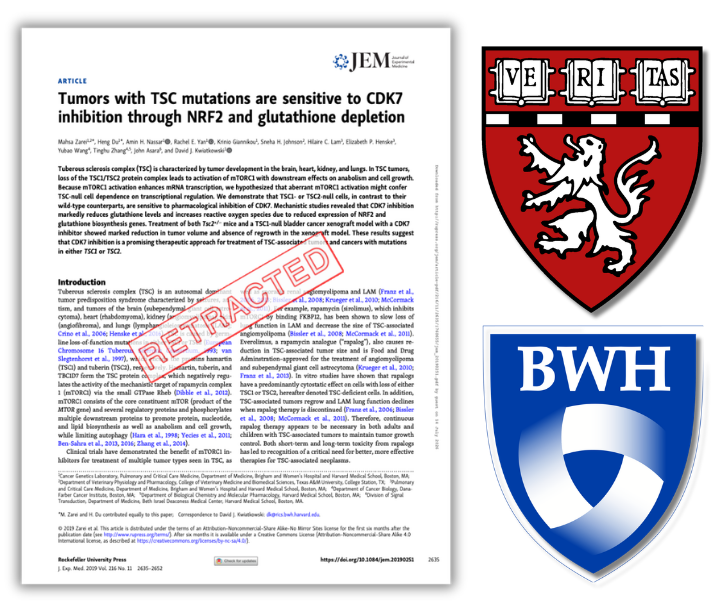
A group of researchers at Brigham and Women’s Hospital and Harvard Medical School in Boston have lost a paper for image duplication following an investigation by the two institutions. 

The paper, published in September 2019 in the Journal of Experimental Medicine, described a treatment for tumors caused by a disorder called tuberous sclerosis complex. Several of the article’s 12 authors are affiliated with Brigham and Women’s Pulmonary and Critical Care Medicine division. Corresponding author David Kwiatkowski is an oncologist at Brigham and Women’s Hospital and Dana-Farber Cancer Institute, and a professor at Harvard Medical School. 

The research was partially funded by two grants from the U.S. Department of Defense and a National Institutes of Health grant, the latter of which was awarded to Kwiatkowski. 

Continue reading Harvard cancer researchers earn retraction for image duplication 
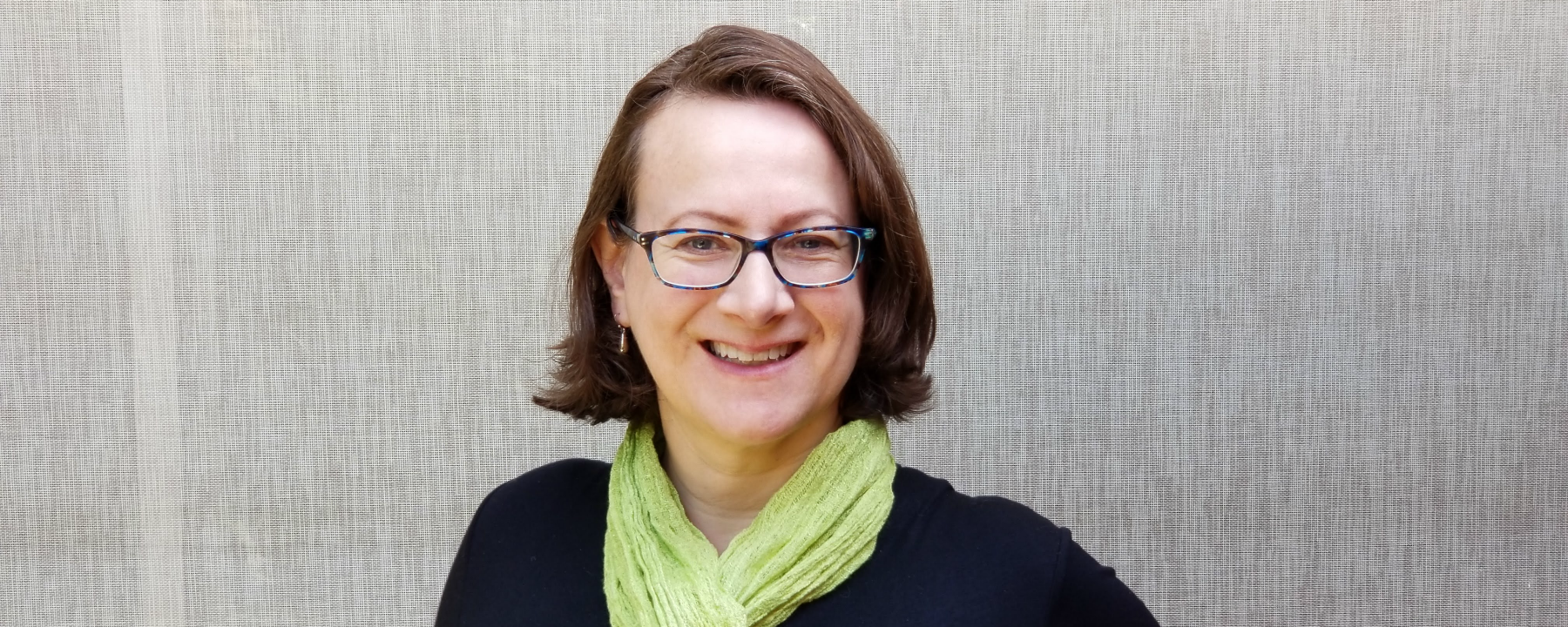
10 years ago, Elisabeth Bik published a preprint heard around the world

Elisabeth Bik

If you are at all familiar with scientific sleuthing, you’re familiar with Elisabeth Bik. She is quoted so often in the mainstream media it is probably difficult to imagine a time before her supersense for spotting similarities in images wasn’t making headlines. 

But it was 10 years ago, on April 19, 2016, when she made her debut, when we covered her work screening more than 20,000 biomedical research papers containing western blots. She and coauthors Ferric Fang – a member of the board of directors of our parent nonprofit organization, The Center for Scientific Integrity, and a professor at the University of Washington in Seattle – and Arturo Casadevall, of the Johns Hopkins School of Medicine in Baltimore, posted the work as a preprint on bioRxiv.org and it appeared two months later in mBio.

The preprint was a shot across the bow for journals and publishers, and in the decade since, Bik has advised and mentored others doing similar work. In 2024, she won the Einstein Foundation Award for “identifying misconduct and potential fraud in scientific publications, highlighting science’s problems policing itself.” She donated the proceeds to The Center for Scientific Integrity to create a fund to help other sleuths do their work.

Bik spoke with us earlier this month about the paper, sleuthing and more. The conversation has been edited for clarity and brevity.

Continue reading 10 years ago, Elisabeth Bik published a preprint heard around the world

Gynecologists in Italy collect more retractions and an expression of concern

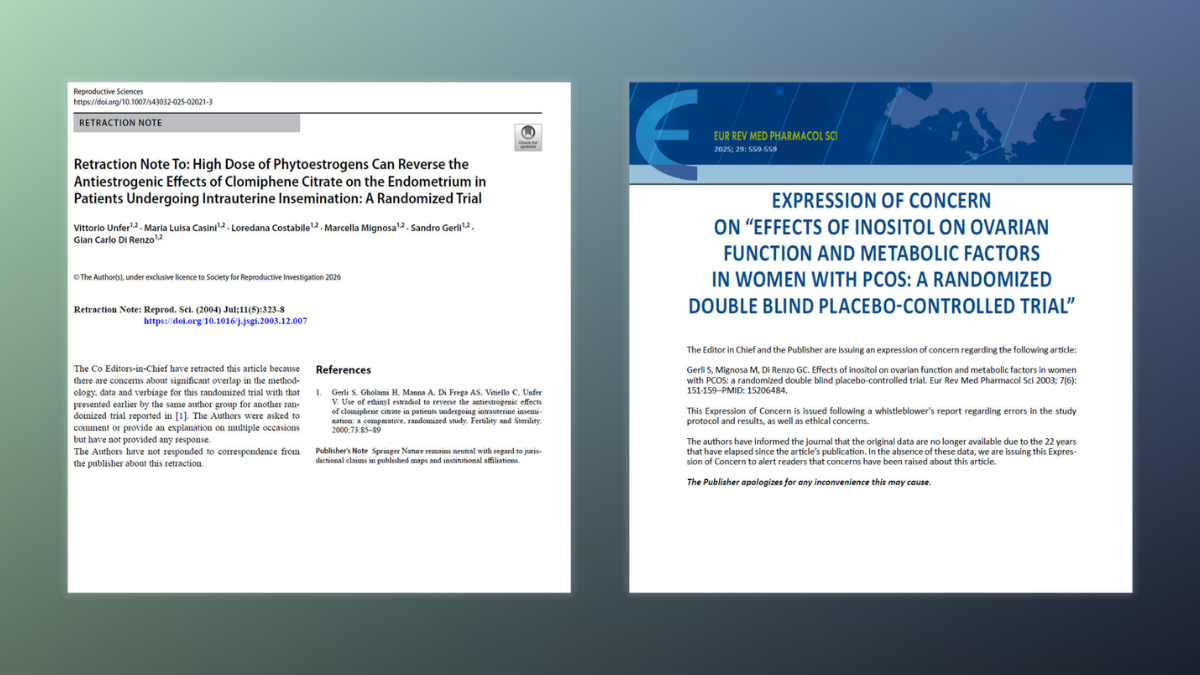
A group of gynecologists in Italy has tallied yet another retraction, this time for an article with “significant overlap” with the methods, data and text of an older paper that shares two of the same authors. 

The paper, which involved research on a treatment for infertility, is the latest in a string of retractions for Sandro Gerli and Gian Carlo Di Renzo of the University of Perugia, and Vittorio Unfer, now at Saint Camillus International University of Health Sciences in Rome. Just a few weeks earlier, the researchers also received an expression of concern on a separate paper examining a widely used supplement for polycystic ovary syndrome. 

Commenters on PubPeer began to flag the researchers’ papers two years ago, and they now have 11 retractions among them, largely for duplicated data and text across the publications, as well as undisclosed conflicts of interest and unreliable study methods. In 2024, Di Renzo threatened legal action over a critic’s allegations about data duplications among several papers he coauthored — many of which have since been retracted. 

Continue reading Gynecologists in Italy collect more retractions and an expression of concern

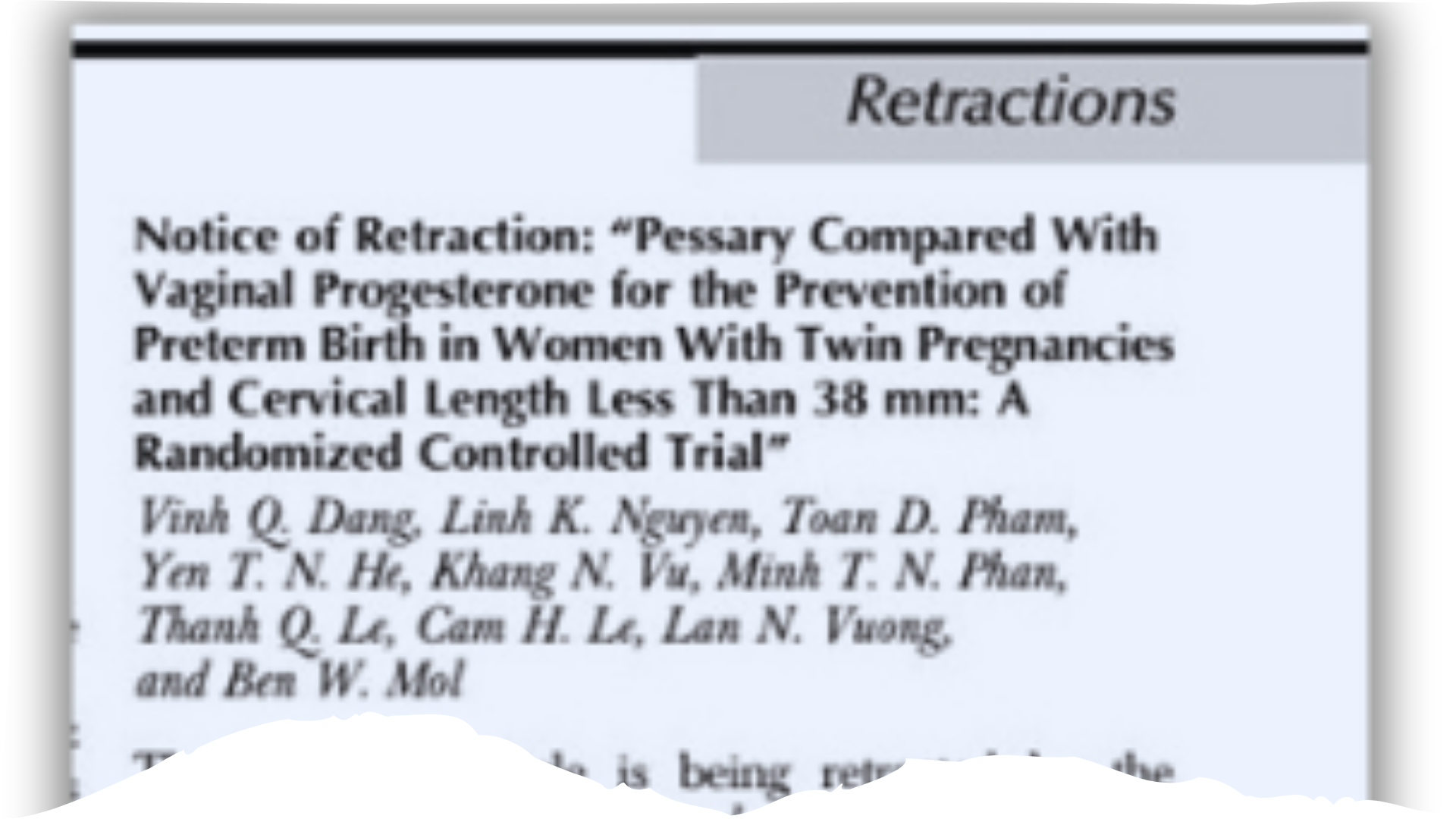
Sleuth loses paper for duplicate publication after flagging hundreds of untrustworthy articles

A sleuth who has identified several hundred articles describing clinical women’s health research with untrustworthy data, leading to nearly 300 retractions, has now lost one of his own papers for duplicate publication. 

Ben Mol, who leads the Evidence-based Women’s Health Care Research Group in the department of obstetrics and gynecology at Monash University in Australia, has worked to raise awareness of problematic data informing medical recommendations for women’s health care, and to cleanse the literature of unreliable studies, with major media outlets covering his work. 

Mol told Retraction Watch about 50 of his papers have been investigated since 2020, usually after anonymous complaints. “It is clear that somebody had been screening my papers … in a systematic way to find any wrongdoing,” he said. His only other retraction came after he and colleagues found an error in their own work and requested the action.

Continue reading Sleuth loses paper for duplicate publication after flagging hundreds of untrustworthy articles

Journal issues speedy retraction in less than a day for ‘inadvertent mistake’ 

We don’t know if it’s the fastest retraction ever, but the speed is nonetheless notable: A journal retracted a paper 22 hours after a sleuth raised concerns about the article. 

On August 9 just before noon, John Loadsman, an anesthesiologist and journal editor in Australia, reached out to two journals to notify them of image similarities he had flagged on PubPeer. 

Loadsman asked the authors to clarify the “apparent identity” of a figure in a 2023 paper in Experimental Biomedical Research. The figure resembled one in a different paper by the same authors “representing different experimental conditions,” he wrote in his PubPeer comment. The second paper appeared in Wiley’s International Journal of Endocrinology in 2019. 

Continue reading Journal issues speedy retraction in less than a day for ‘inadvertent mistake’ 

Cardiology researcher in Italy up to 17 retractions, most for duplication

A heart researcher from Italy has lost three papers because the articles duplicated work he had previously published. The retractions bring his tally to 17, all but one of which were for self-plagiarism.

The latest retractions for Renato De Vecchis were from the Journal of Clinical Medicine Research (JCMR). JCMR is published by Elmer Press and is not indexed in Clarivate’s Web of Science. De Vecchis most recently listed his affiliation as San Gennaro dei Poveri Hospital in Naples. He was previously at  Elena d’Aosta, a health center in Naples. His published papers are all in cardiology research.

Richard Liu, the director and CEO of Elmer Press, told us JCMR “informed the related journals” of similarities between publications. He also said the journal never heard back from the authors but “since the contents overlapped are significant [sic],” the journal decided to retract the papers. 

Continue reading Cardiology researcher in Italy up to 17 retractions, most for duplication

Researcher removed from journal masthead, loses three more papers

A management journal has removed from its masthead an editor who was the subject of a Retraction Watch post last month.

Shalini Srivastava, a professor at the Jaipuria Institute of Management in India, was an associate editor at Employee Relations, an Emerald Publishing title. We reported last month that two articles she coauthored — one in Employee Relations and another in the Journal of Organizational Change Management, also an Emerald journal — were retracted because “a large portion of this article’s models, samples, and results are taken, without full and proper attribution, from” earlier work, both retraction notices read.

Following our report, Srivastava’s name disappeared from the editorial team page of Employee Relations. Asked to comment on the change, a spokesperson from Emerald’s research integrity department replied:

Continue reading Researcher removed from journal masthead, loses three more papers

Pair of management papers retracted for similarities to earlier work

Two management journals from the same publisher have retracted a pair of articles for taking “models, samples, and results” from each other and earlier work. 

A tip from an anonymous account sent in November to Retraction Watch, sleuth Elisabeth Bik, and others called out duplications in the papers. Bik then posted the two articles on PubPeer in November 2024, noting several identical sets of tables between the papers, despite the works investigating survey data on different topics from different populations — intention to leave among employees from the hospitality sector, and resistance to change among managers at private organizations.

Continue reading Pair of management papers retracted for similarities to earlier work

University president faces allegations of duplication, institution says no misconduct

Masahiro Yoshimoto

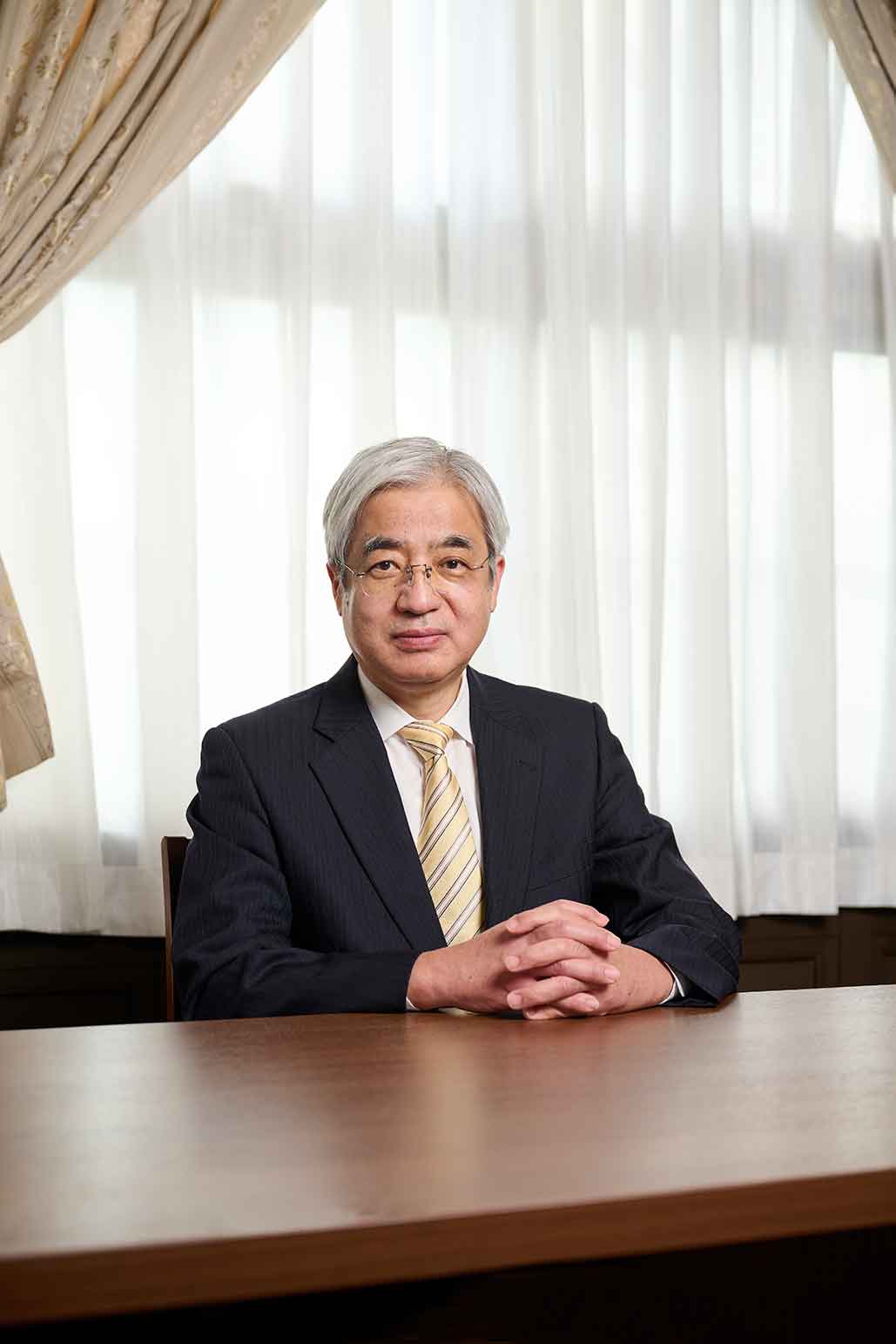
The president of the Kyoto Institute of Technology (KIT) has corrected two of his papers and is set to correct another amid allegations of duplication – sometimes inelegantly referred to as “self-plagiarism” – despite a university committee clearing him of misconduct. 

Employees at the university have accused president Masahiro Yoshimoto of duplication between 11 sets of his published papers – implicating 34 papers in total. 

The employees submitted the allegations to the institution last October, backing their claims with an analysis by plagiarism detection software iThenticate. Two of these employees spoke to Retraction Watch on condition of anonymity, fearing a loss of support from their colleagues if they spoke publicly. Their concerns triggered an investigation at KIT, which cleared Yoshimoto of misconduct in January. However, the whistleblowers still believe the papers should be retracted. 

Continue reading University president faces allegations of duplication, institution says no misconduct

Exclusive: Wiley journal editor under investigation for duplicate publications

Daniel Joseph Berdida

An academic editor at Wiley who vowed to “uphold publication ethics” is being investigated by the company for allegedly publishing three of his papers twice, in violation of journal policies, Retraction Watch has learned.

One of the duplicates, which appeared last year in Nurse Education in Practice, an Elsevier title, has already been slated for retraction, according to emails we have seen. The other offending articles were published in Wiley journals.

The editor, Daniel Joseph Berdida, is a nurse and faculty member at the University of Santo Tomas in Manila, the Philippines. He joined the editorial board of Wiley’s Journal of Nursing Management four months ago, announcing on LinkedIn that he would “be serving with integrity and uphold publication ethics.”

Continue reading Exclusive: Wiley journal editor under investigation for duplicate publications